


.svg)

.svg)


From Storytelling to Strategic Quality: Why L&D Needs a Systematic Approach to Excellence



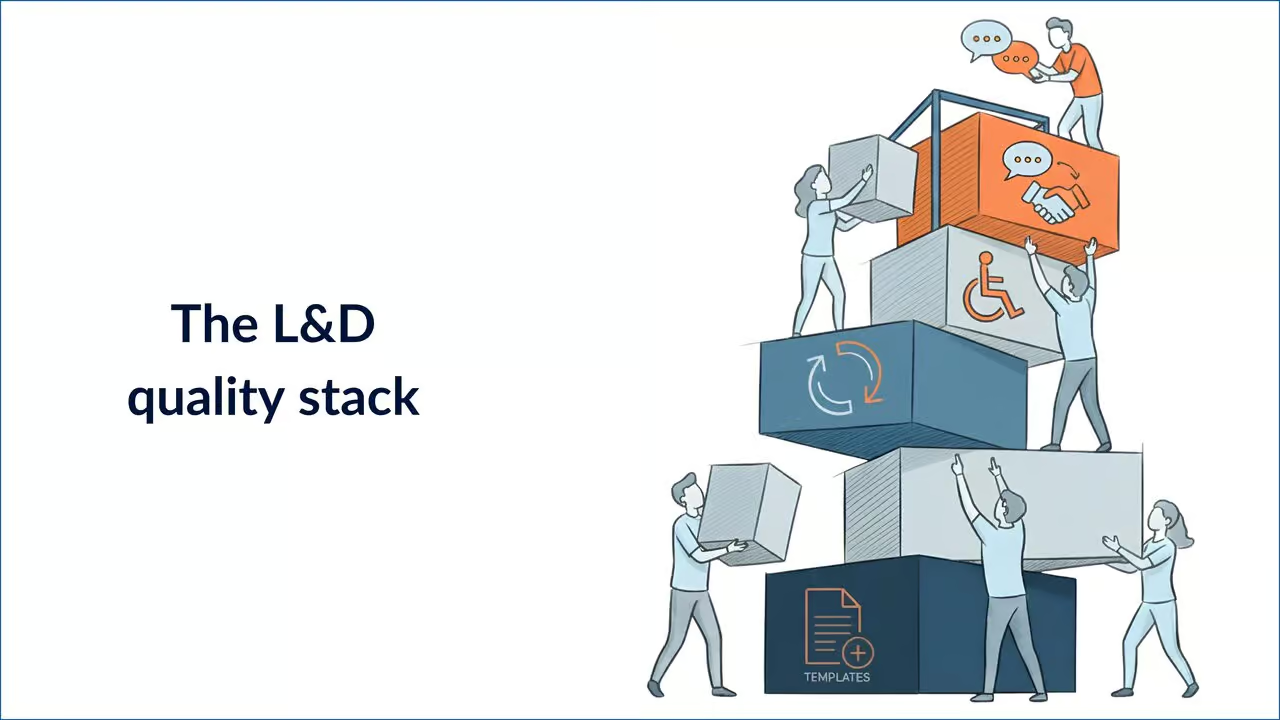
Learning and development teams face growing expectations. Organizations want learning experiences that improve performance, deliver measurable results, and align directly with business goals. Yet many teams still rely on informal review cycles, subjective feedback, and inconsistent standards across their content authoring process.
In a recent episode of Instructional Designers in Offices Drinking Coffee, Hadiya Nuriddin — CEO and Chief Learning Strategist at Duets Learning — explained how her journey from storytelling expert to quality-management professional reshaped her approach to L&D excellence.
Her message is clear:
L&D can’t depend on “fix it in review” cycles. Quality must be built into the content authoring process from the start — not discovered at the end.
Her Quality Stack framework offers a practical path to making that shift.
Why Traditional Review Cycles Hold Learning Teams Back
For many instructional designers, review cycles are the most stressful part of content development. When stakeholders provide vague feedback like “We don’t like this,” designers are left guessing about expectations — often leading to unnecessary rework.
Without a shared definition of quality, teams struggle with:
- Endless revisions and conflicting opinions
- Subjective feedback that varies by reviewer
- Delays and last-minute fixes
- Frustration for both designers and SMEs
This isn’t just a workflow issue — it’s a quality management issue. And it’s one that costs organizations consistency, time, and learner impact.
What L&D teams need is a common definition of quality and a system that supports it across the entire content authoring lifecycle.
The Quality Stack: A Framework Built for Modern L&D Teams
After studying with the American Society for Quality (ASQ), Nuriddin created the Quality Stack, a five-layer model designed to embed quality into every part of instructional design, eLearning authoring, and content development.
1. Mission: Define What “Quality” Means
Every organization must create its own definition of high-quality learning. Examples include:
- “A quality course reflects real workplace tasks and decisions.”
- “A quality module drives measurable behavior change.”
This mission becomes the foundation for the entire content authoring and review process.
2. Scope: Where Do These Standards Apply?
Quality standards only work when everyone is clear about their boundaries.
Scope defines whether standards apply to:
- all eLearning content,
- only compliance programs,
- or high-impact performance-focused initiatives.
Clear scope prevents misunderstandings and keeps teams aligned.
3. Guidelines: Turn the Mission Into Action
Guidelines translate big ideas into practical direction such as:
- “Use scenario-based learning.”
- “Follow accessibility guidelines.”
- “Use this template for SME interviews.”
Clear guidelines reduce ambiguity and help designers work with confidence.
4. Quality Control: Tools and Systems That Support Quality
Quality control makes the guidelines achievable and repeatable. Examples include:
- Templates and themes
- Brand and accessibility standards
- Reusable content blocks
- Review workflows
- Style guides
These become the guardrails that keep quality consistent — especially across large teams.
5. Quality Review: Validate What Was Built
Review is now objective, not subjective.
Instead of “I don’t like this,” teams evaluate:
- Does the course follow the guidelines?
- Does it reflect the mission and scope?
- Does it meet instructional and accessibility standards?
Review becomes confirmation, not guesswork.
Grounding Quality in Research-Based Instructional Design
Quality shouldn’t rely on personal preference. Nuriddin emphasizes using research-backed frameworks such as Merrill’s First Principles of Instruction, which align with most established learning theories.
These principles support quality criteria like:
- Problem-centered learning
- Activating prior knowledge
- Demonstration and modeling
- Practice and application
- Integration into real-world tasks
When these principles guide content authoring, teams get consistent, evidence-based instructional quality.
Why Quality Requires Better Learning Data
Modern L&D teams need data that goes far beyond completions.
Quality systems become stronger when teams track:
- Learner behavior
- Real-world performance changes
- Long-term retention
- Business impact
This data helps refine guidelines, improve content authoring workflows, and prove L&D’s value to leadership.
The Biggest Challenge: Making Quality a Priority
Even with strong frameworks, quality can slip when deadlines creep or priorities shift.
For quality to stick, organizations need:
- Leadership buy-in
- A clear process owner
- Time for teams to learn the system
- Tools that reinforce quality throughout the content authoring cycle
Starting with pilot projects is often the easiest path — proving value before scaling.
How dominKnow | ONE Strengthens Quality Across the Learning Lifecycle
Modern learning teams need platforms that help them scale their content authoring while maintaining consistent quality. dominKnow | ONE supports the Quality Stack by providing a cloud-based, collaborative authoring and learning content management system (LCMS) designed for repeatable, high-quality eLearning development.
Define Mission and Vision Together
- Real-time collaboration to align on quality standards
- Shared workspaces for visibility into mission and guidelines
- Role-based permissions to support ownership
Manage Scope Through Structured Project Templates
- Templates embed standards directly into every new project
- Version control ensures consistency across teams
- Centralized content libraries maintain a single source of truth
Turn Guidelines Into High-Quality, Repeatable Content
- Built-in templates and themes enforce instructional and brand quality
- Accessibility checking is integrated throughout the authoring process
- Reusable learning objects support scalable content reuse
Strengthen Quality Control With Workflow and Review Tools
- Predefined approval routes streamline collaboration
- Commenting and markup keep feedback actionable
- Tracking tools help teams stay aligned and avoid rework
Validate Quality Before Publishing
- Final approval gates confirm content meets standards
- Multi-format publishing ensures consistent outputs
- Built-in analytics support continuous improvement
With dominKnow | ONE, learning teams get a platform that reinforces quality at every step — from planning to authoring, review, publishing, and maintenance.
The Future of L&D Starts With Quality
Organizations expect more from L&D than ever before: quality, consistency, performance impact, accessibility, and measurable outcomes.
Frameworks like the Quality Stack give teams the structure to deliver these consistently.
Platforms like dominKnow | ONE give them the tools to make it repeatable and scalable.
The real question for today’s L&D leaders is:
Are your quality processes helping your team scale — or slowing them down?
With the right framework and the right authoring platform, quality becomes a strategic advantage — not a last-minute scramble.